



There is little doubt that artificial intelligence has altered the tempo of modern life.
Tasks that once required teams and quarters now take a single engineer and a weekend. Code is conjured in hours. Campaigns are composed in minutes. Molecules are modeled in days. In nearly every field, from film animation to drug discovery, the friction of creation has thinned.
Productivity has become preternatural.
And yet a quieter question lingers beneath the applause: what has this acceleration done to us?

Even before the rise of generative AI, we were living through what the U.S. Surgeon General has called an epidemic of loneliness, affecting nearly half of American adults. Time spent with friends in person has declined dramatically over the past two decades. Anxiety and depression rates have climbed, particularly among young adults. Meanwhile, the average person now spends every day engaging with screens rather than with friends and loved ones
We have become extraordinarily efficient, and increasingly alone.
AI emotional companions now populate the digital landscape. They are available at all hours. They are endlessly patient. They do not interrupt, withdraw, or bruise. But one cannot help wondering whether what is optimal for productivity may be corrosive to intimacy. The frictionless exchange is not always the formative one. The quick answer is not always the deep answer or the one you need to hear.
Patience. Discomfort. Silence. Even boredom.
These are not glitches in human connection. They are its very bedrock.
The economist Albert O. Hirschman, too often overlooked, and in my view one of the twentieth century’s great moral thinkers, offered a framework that feels uncannily suited to this moment. In Exit, Voice, and Loyalty, he described the three responses available to us when faced with dissatisfaction:
We can exit, leave the relationship, abandon the difficulty.
We can remain in loyalty, stay, but silent.
Or we can exercise our voice, remain, and speak.
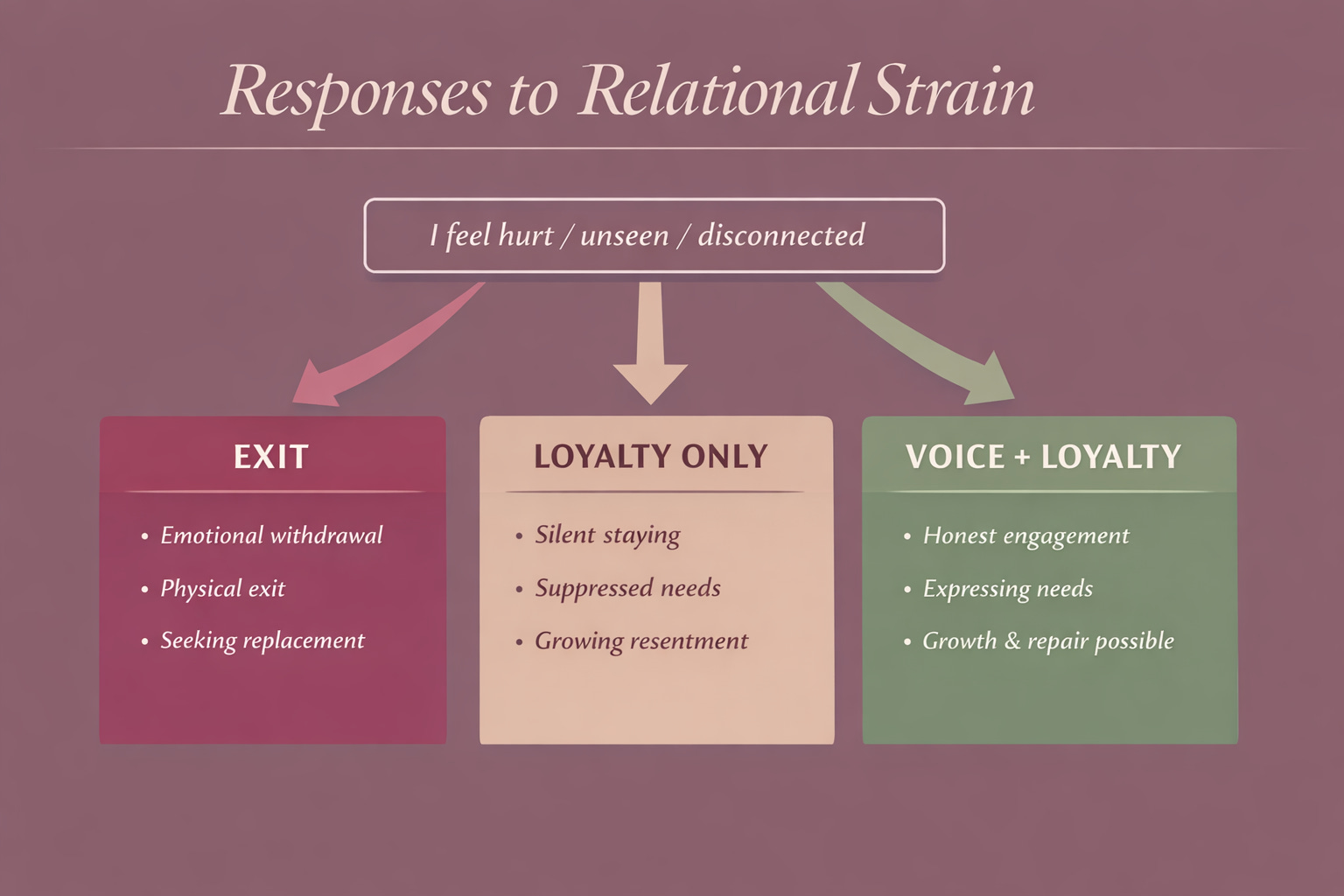
Voice is the most demanding path. It requires vulnerability. It requires friction. It requires staying long enough for repair.
Our digital architecture, however, has been quietly optimized for exit. Swipe. Scroll. Replace. The cost of departure has never been lower. The average dating app user encounters more potential partners in a month than previous generations might have met in a lifetime. Optionality has expanded; endurance has not.
The Jungian analyst James Hollis writes that relationships inevitably summon our unfinished business. They introduce us to the parts of ourselves we would rather not confront, insecurity, fear of abandonment, shame. “The expectation that another will save us,” he argues, “is the core illusion.” When we leave to escape discomfort, we do not leave our unfinished work behind. We carry it forward.
And so the deeper question for technologists is not how to simulate companionship, but how to scaffold courage.
What would it mean to design systems that encourage voice rather than exit? That slow reflexive withdrawal rather than reward or even encourage ? That helps people remain present long enough to say the harder thing?
This is not something a generic large language model can accomplish by default. Large models are trained for fluency. For agreeableness. For seamlessness. They smooth. They soothe. They respond. They revert people to the comfortable mean.
But meaningful relational growth is not a smooth, easily digestible checklist, not the ten tidy steps to relationship bliss. As one of my high-school teachers used to say, there are no shortcuts to life. The work must be done. It unfolds over time. It requires memory, not just of words, but of patterns. It requires guardrails, knowing when to validate and when to gently challenge. It requires continuity, an arc that spans months, not minutes.
If the first wave of AI has been about acceleration, the next must be about anchoring.
Consider this: nearly 70% of couples report recurring conflicts they never fully resolve, and only a minority ever seek professional support. The problem is not a shortage of language. It is a shortage of containment. A shortage of guided repair.
At OurRitual, we are building technology designed for connection. Not technology that replaces the work of intimacy, but technology that protects and strengthens it. AI trained on structured, longitudinal therapeutic data. Systems designed to encourage voice over exit. To help couples stay in difficult conversations rather than escape them.
This cannot be achieved with a simple LLM wrapper. It requires AI built with intention, engineered specifically to hold the courage of difficult connection. Designed not merely to generate text, but to sustain growth. Not merely to respond, but to remember. Not merely to comfort, but to scaffold repair.
If the first wave of AI has been about acceleration, the next must be about anchoring.
Not faster conversations.
Braver ones.
Not infinite optionality.
Intentional commitment.
Technology will continue to reshape the world. The question is whether we design it to help us exit discomfort, or to help us grow through it.
We believe the future of AI in relationships is not about replacing intimacy. It is about strengthening the conditions in which intimacy can endure. And that is a very different kind of system.
David Pruwer, Co-founder and CEO