

Therapy Was Designed for 1913
Humanity has changed. Therapy needs to catch up.


Therapy has a design flaw. Research shows that quality therapy rewires relationships, improves physical health, and breaks generational cycles. [5] The practice of therapy has never been the problem.
The delivery system is the problem. And almost nobody in this industry is willing to say it.
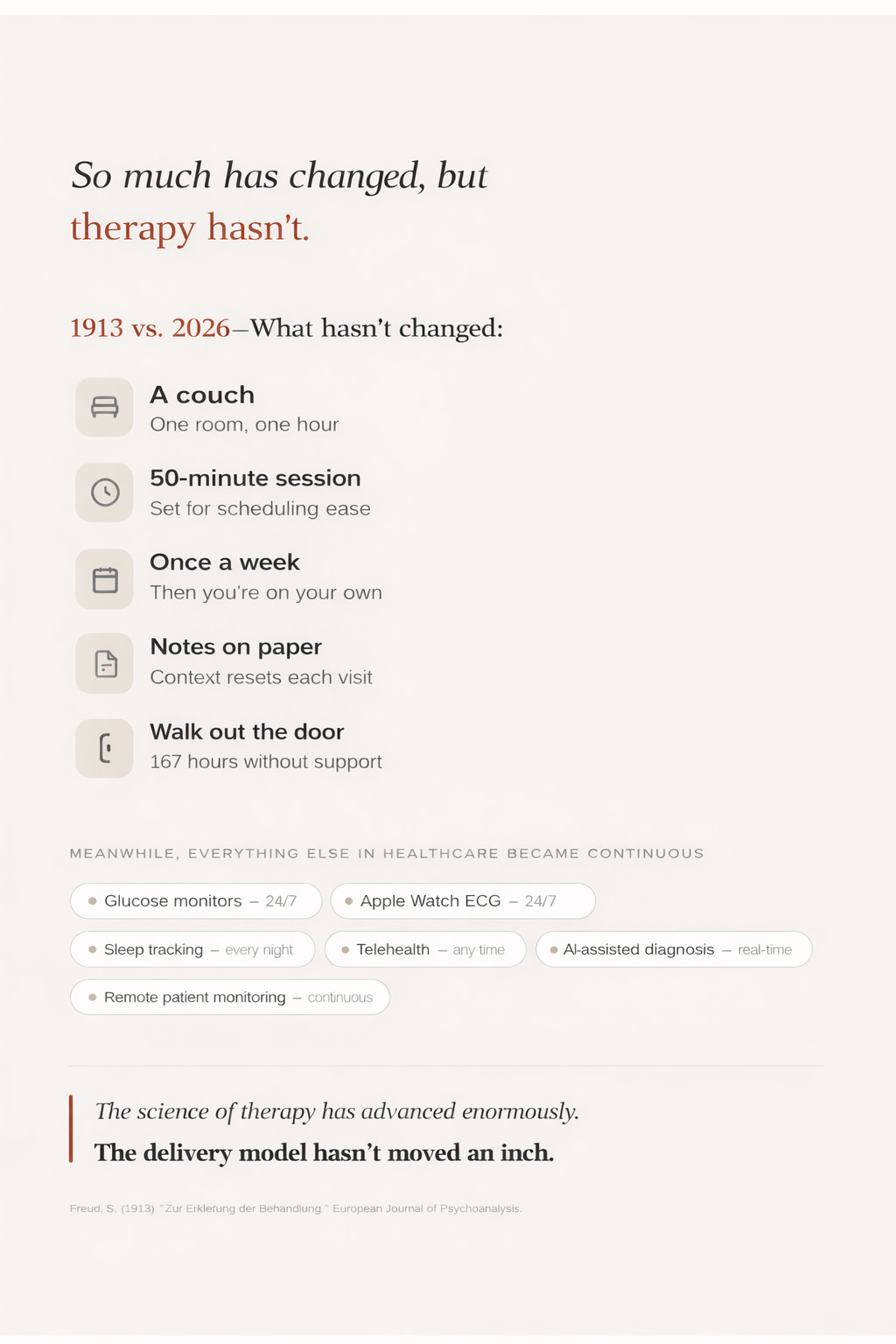
Here’s the design flaw: therapy ends when the session does.
You sit in a room for 50 minutes. You surface something real: a pattern, a wound, a breakthrough. Then you walk out the door and into 167 hours of… not therapy. No support. No guidance. No one there when the old fight reignites at dinner, when the resentment returns at bedtime, when you’re lying awake at 1AM replaying every word and wishing someone, anyone, could help you see it differently.
One hour of support. One hundred and sixty-seven hours alone. That’s the ratio the entire industry was built on. And for over a century, nobody questioned it.[1]
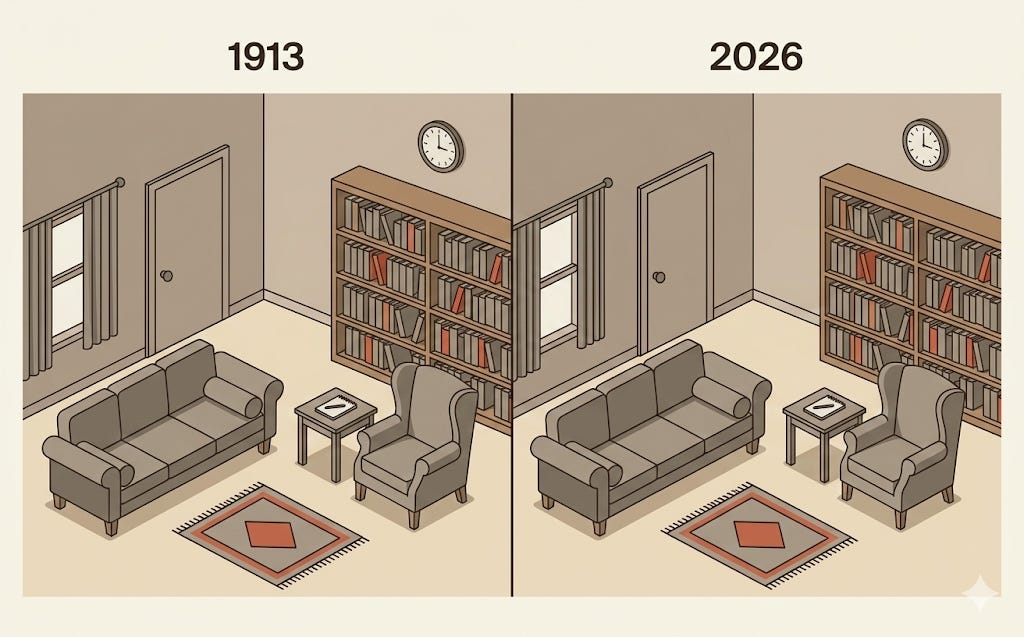
It’s 2026. We have questions.
Let’s be honest about what’s happening.
Up to 60% of couples drop out of therapy before making meaningful progress.[2] Not because therapy doesn’t work, but because the model sets them up to fail. You can’t build a new muscle in one hour a week and expect it to hold under pressure the other 167 hours. You wouldn’t train for a marathon that way. You wouldn’t learn a language that way. You wouldn’t try to get physically healthy by exercising once every fourteen days and white-knuckling the rest.
But that’s exactly what we ask of people trying to save the most important relationship in their lives.
Meanwhile, the vast majority of couples who need support have nothing built for them. Not because their relationships are fine, but because nothing was designed for how they actually live. The model dates back to 1913 when a therapist’s office was the only possible container for emotional work, when there was no technology capable of something different, and when nobody imagined that one day people would pour their most vulnerable moments into an AI chatbot at midnight because they had nowhere else to turn.[1][7]
That day is here. A rapidly growing number of young adults are already using AI for mental health support.[4] They’re taking their fights, their fears, their loneliest moments to ChatGPT — a tool trained on the internet, not on clinical expertise. A tool that gives the same generic script every time, whether you’re dealing with a communication hiccup or a two-year erosion of trust.
People aren’t choosing AI because it’s good enough. They’re choosing it because nothing else shows up. The industry left a void, and the internet filled it, badly.
That tells us everything we need to know. The demand for continuous relationship support isn’t theoretical. It’s already here, and it’s massive. What’s missing is a version that actually works, one built on clinical expertise, not internet scraping. One that knows your relationship, not relationships in general.
I know this gap personally. Not as a product insight, but as a lived experience.
A few years ago, my relationship looked like a storybook from the outside. I met my wife in the U.S., convinced her to move to Israel, got married, and started building a life together. But like in so many relationships, nobody sees what’s beneath the surface; the loneliness, the guilt, the day-to-day struggles, the big questions nobody prepares you for.
When our son was born during the pandemic, everything cracked open. We had lost intimacy, connection, confidence, and ourselves. The resentment was intertwined with guilt. I just knew there had to be another way to live life with the person I loved most.
The strangest part? When I finally started talking about it, almost everyone around me was dealing with the same thing. We all just avoided saying it out loud. Maybe that’s a guy thing. Maybe it’s a human thing.
That gap between what relationships need and what the world offers became impossible to unsee. And once you see it, you can’t look away. You start asking: why does an industry built to help people connect leave them so alone between conversations?
So we built something different.
Over the past three years at OurRitual, we’ve logged over 200,000 therapy sessions with more than 200 licensed relationship experts.[6] Not chatbot conversations. Not self-help prompts. Real, clinically validated sessions where we can track with outcome data what actually moves the needle for each couple.
The session creates the insight. The 167 hours determine whether it survives.
Here’s what 200,000 sessions taught us: the most meaningful change doesn’t happen in the session. It happens between sessions. When couples try a different approach to an old argument. When they catch themselves mid-pattern. When they choose repair instead of retreat. When they process a trigger before it becomes a three-day cold war. The session creates the insight. The 167 hours determine whether it survives.
The couples who improve fastest aren’t the ones in the most sessions. They’re the ones who have support when it matters; on a Tuesday night, in the car after a hard conversation, during the silent hours when you’re building a case in your head and nobody’s there to interrupt the spiral.
This is the insight the industry has been ignoring. And it led us to build something we believe is a new category entirely.
We call it Continuous Therapy.
Continuous Therapy is the end of the appointment-only model. It’s the conviction that relationship support should be woven into daily life: present when you need it, informed by real clinical context, designed to meet you in the moment instead of six days later on a couch.
It’s not “AI therapy.” It’s not a chatbot pretending to be a clinician. It’s something that hasn’t existed before: a system where expert therapists build trust and clinical depth, and intelligent technology, trained on hundreds of thousands of real therapeutic interactions, not internet data, extends that understanding into everyday life. Where context compounds with every session instead of resetting. Where support gets smarter the longer you stay, not just the more you pay.
Our users engage over 4 times more than traditional therapy. 80% come back every single week with engagement rivaling the best consumer products in the world.[6] Not because we’ve gamified anything. Because for the first time, support actually matches the rhythm of a real relationship.
This is what we’re building. This is the category we’re defining. And this publication — Between Sessions — is where we’ll share what we’re learning as we build it. Our clinical insights from 200,000 sessions. The technical challenges of building AI that’s deeply personal without being invasive. The product philosophy of meeting people where their lives actually happen.
Therapy was designed for 1913. The weekly slot. The 50-minute hour. The waiting room. The referral. All of it built for a world with no smartphones, no AI, and no understanding that relationships need continuous support, not periodic intervention.[1]
The science of therapy has advanced. The delivery model hasn’t moved an inch. An entire industry optimized the session and forgot about the life around it.
We’re done accepting that.
We accept continuous monitoring for our heart rate, our glucose, our sleep cycles. We’ve decided that physical health deserves always-on intelligence. But for the single most important predictor of our happiness, our longevity, and the wellbeing of our children, we still offer one hour a week and a pat on the back.[5]
We believe relationships deserve what the rest of healthcare is already getting: support that’s continuous, intelligent, and human at its core. That’s what we’re building. And we’re just getting started.
What exactly are we protecting by keeping it the way it is?
And who decided your relationship doesn’t deserve better?
References
[1] Freud, S. (1913). “Zur Einleitung der Behandlung” (On Beginning the Treatment). The 50-minute session format traces to Freud’s 1913 paper on analytic technique. European Journal of Psychoanalysis.
[2] Doss, B.D., et al. (2011); Kazdin, A.E., et al. (1997). Research spanning decades finds 20–60% of couples who begin therapy are not retained through the treatment plan.
[3] Masi, M.V., Miller, R.B., & Olson, M.M. (2003). “Differences in dropout rates among individual, couple, and family therapy clients.” Contemporary Family Therapy, 25(1).
[4] RAND Corporation / JAMA Network Open (2025). “Use of Generative AI for Mental Health Advice Among US Adolescents and Young Adults.” 13% of youth ages 12–21 use AI for mental health advice; ~22% among ages 18–21.
[5] Harvard Study of Adult Development (1938–present). The longest-running study on human happiness finds close relationships are the single most important predictor of health, happiness, and longevity. Harvard Gazette (2017).
[6] OurRitual internal data: 200,000+ therapy sessions, 200+ licensed relationship experts, 4x engagement vs. traditional therapy, 80% weekly return rate.
[7] PBS / American Experience. “The Surprising History of Marriage Counseling.” Origins of marriage counseling from the 1920s–1930s onward.
 | A guest post by
|
Working on ourselves and our relationships is a lifelong journey, continuous support makes it more sustainable!