



There’s just something about walking into a new therapist’s office for the first time.
You’re nervous, a bit like a first date, but you already know you’re the one who’s paying, and maybe also crying, and there will definitely be no kissing.
You look around and take in the space around you, doing calculus in your head.
These rooms come in different varieties, and they all carry with them a particular energy of some kind:
Ikea furniture, generic paintings, a fake (?) plant.
Prayer beads, tantra and “yoni” books, the smell of incense.
A tiny play table and coloring books in the corner for tiny patients.
Diplomas on the wall in an old-world cursive you can never make out from where you’re sitting.
The tissue box, standing tall, maybe next to a pre-filled glass of water, from which you will certainly sip nervously from, if not from thirst.
With an industry as sensitive and personal as therapy, how do you give a digital introduction that immediately gives people the sense that they’ve come to the right place?
Building a brand for a digital couples counseling platform isn’t just about choosing the right carpet for the proverbial waiting room, it’s about expressing the work that’s happening, the revelations you’re having, and the life you’re living.
No easy feat.
Looking at our competitors, the branding is clean, almost medical, and very digestible, like a candy-coated pill. The branding is decidedly green. If you didn’t know any better, you could confuse them with an insurance provider or a medical supplies distributor. They are clearly doing something right. But we want to do something different.
I’m a big believer that websites and digital experiences are the new public places, the new locus of many of our customer experiences. Seeing a restaurant with white tablecloths means something to diners, so how else is value transmitted in the digital age?
I’ve spent a lot of time researching and considering the value of OurRitual, and how to translate that visually and emotionally.
Other online therapy platforms offer a digital solution for an in-person experience, whereas OurRitual is a digital experience at its core, leveraging AI and personalized digital experiences as a means to make progress, not as a “next best” option to in-person support.
Seeing a restaurant with white tablecloths means something to diners, so how else is value transmitted in the digital age?
So, what are the core principals that drive how we present the OurRitual brand to the outside world?
When we started building OurRitual, we kept coming back to a simple question: what would relationship support look like if it were designed for how people actually grow?
A few principles shaped what we showed and how:
1. The work doesn’t only happen in the session
Sessions matter, of course. But most of the real work happens in between; in the moments when a conflict pops up, when you’re trying a new communication pattern, or when something finally clicks.
So, instead of centering everything around the appointment, we built a hybrid model: expert sessions paired with exercises, short videos, and guided activities you can return to whenever you need them.
2. Progress needs somewhere to live
In traditional therapy, insights can disappear quickly. You talk about something meaningful, and then life moves on, and so do your thoughts and actions.
We wanted a place where people could build on what they’re learning over time: revisit ideas, try new practices, and keep momentum between sessions.That happens in the new type of therapeutic space: our phones. The OurRitual app is meant to offer a relationship care toolbox to our members, so they feel supported 24/7.
3. Relationship work shouldn’t require a partner to start
One of the biggest barriers we see is that people want to work on their relationship… but their partner isn’t ready, interested, or available.
So we designed OurRitual to support both individuals and couples. You can start the work on your own and still build skills that affect your relationship.
4. Technology should support the process, not replace it
There’s a lot of hype around AI in mental health right now. Our view is simpler: technology should make good guidance more accessible and easier to apply in real life.
The goal isn’t to replace therapists, on the contrary, it’s to make their insights more available, more contextual, and easier to use when you actually need them.
5. No two relationships grow the same way
Some people come in wanting to work on communication. Others are navigating parenting stress, rebuilding trust, or figuring out boundaries.
So instead of a single fixed program, experts help guide people through different journeys depending on where they are and what they want to work on.
None of these ideas are revolutionary on their own. But together they point toward something we believe strongly: relationship growth works best when support is continuous, flexible, and integrated into everyday life, not limited to a single weekly conversation.
That’s the philosophy we’re building around.
So, when people take a seat in our digital waiting room, or sign onto our virtual therapy room - what should they see, smell, and most importantly, feel?
***
When I was called on to refresh the OurRitual brand alongside the other creatives on the team, we were not trying to make something that looked like therapy. We wanted to define and create a new, more holistic resource that goes beyond common perceptions of what therapy is (and isn’t).
This is what that looks like:
Technology in service of care
OurRitual blends expert guidance with digital tools and AI support, so the brand needed to balance modern technology with a deeply human tone.
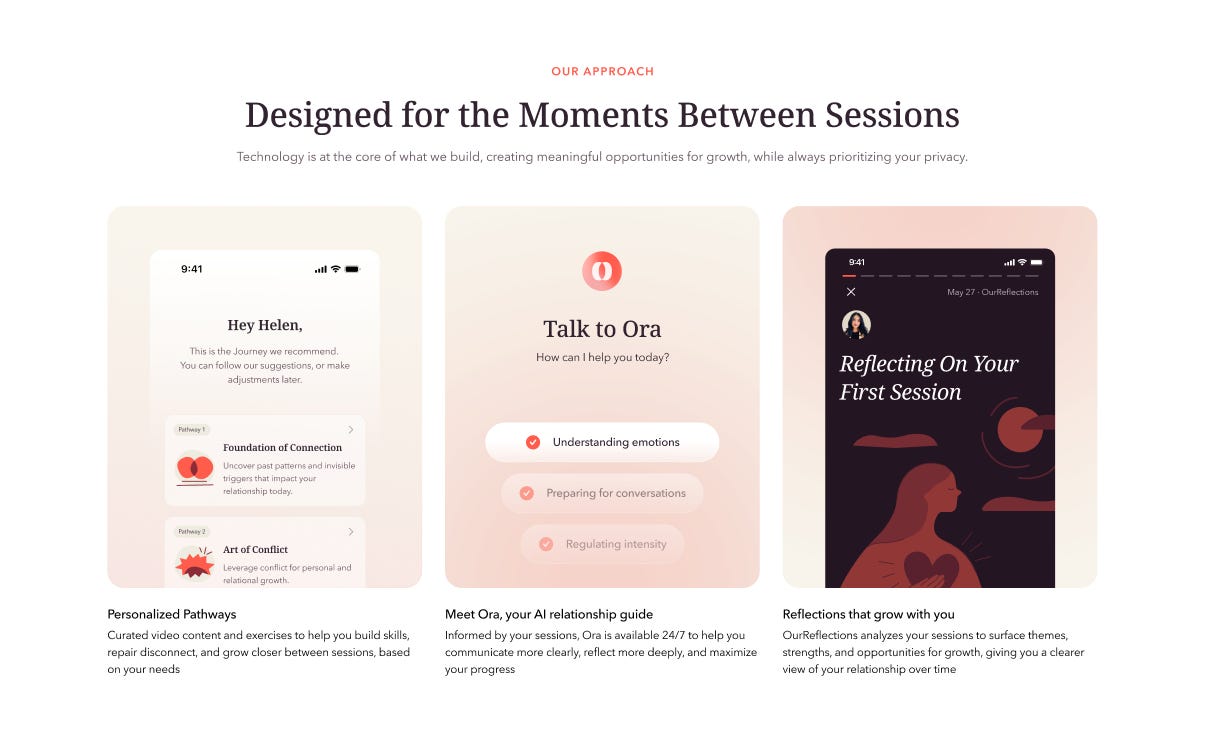
The design language is contemporary and mobile-first, reflecting that the experience lives in a digital space. At the same time, it avoids the coldness often associated with tech brands. The goal is to make technology feel like the spine that holds up the experience, not an additional hurdle to clear on your way to relief.
You can see that balance in how we present the product across surfaces. The interface is clean and intuitive, but the surrounding brand language, illustrations, and videos keep the experience grounded in human relationships rather than software.
Support that feels calm, not clinical
Because OurRitual is meant to live alongside everyday life, we wanted the visual world to feel grounded and steady rather than medical or overly polished.
The palette leans warm and muted. The colors are meant to feel soothing without feeling fragile. The pacing of layouts, motion, and typography is intentionally breathable.
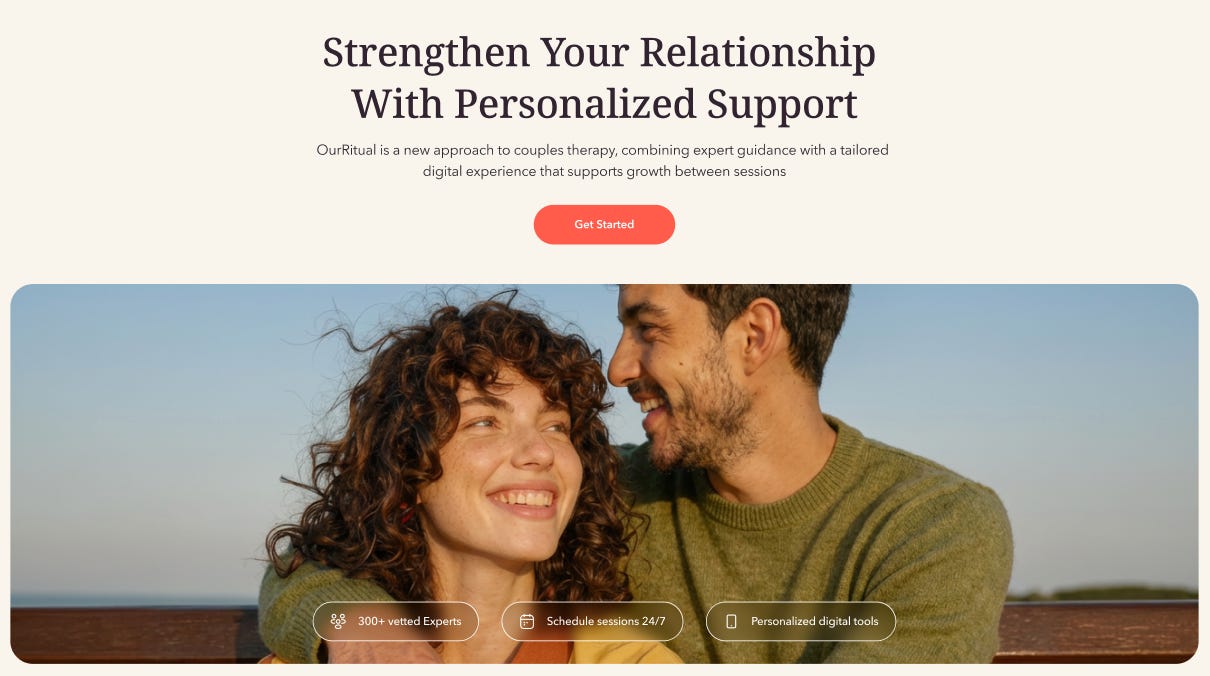
When someone encounters the brand, whether in the app, on the website, or through content, the goal is the same. The environment should feel calm enough that people can engage with difficult topics.
Progress, not perfection
Relationship growth is rarely neat. It is iterative and often nonlinear.
It’s important that we don’t oversell or make assumptions about what our product can do. Relationships at any stage take work, and sometimes couples work is about reaching an ending, sometimes it’s about healing from a betrayal, and sometimes it is about fortifying already present skills. Sometimes, it’s about a lot of things. OurRitual can help make that work more accessible, clearer, and more streamlined, but it isn’t a quick fix or a magic elixir for a happy relationship.
You can see this in how we create content. Videos, social posts, and expert insights focus less on perfect relationship outcomes and more on the small moments where people try, adjust, and learn together.
Human, but not sentimental
Many brands in the relationship space lean heavily into sentimentality. We deliberately avoided that.
Instead, the tone is warm, thoughtful, and emotionally intelligent without becoming overly sweet or romanticized. The goal is to meet people where they actually are, which is often somewhere between hopeful and overwhelmed, and sometimes in the midst of something supremely painful. We never want to assume, but we always want to be open and non-judgemental.
Collaborations with Couplet and Escargot reflect that same instinct. They approach relationships with curiosity, cultural awareness, and a bit of wit rather than sentimentality.
They expand the conversation around relationships in ways that feel contemporary, humorous, human, and tech-driven, much like our daily lives.
I’m looking forward to continuing the challenge of building this brand. Because much like that first session with a new therapist, we need to unpack in order to reveal, and we need to discover in order to build.
This is only the beginning. Our time for this week is up.

